

If you've ever looked at a fine art print and thought "I could get a poster for ten bucks," that's fair. I get it. Let me explain what you're actually paying for when you buy a proper giclée print.
The Paper
This is where most of your money goes, and it's also where most of the quality lives.
Our prints are made on 100% cotton rag paper. It's acid-free, heavyweight (300+ gsm), and it feels like something when you hold it. Not flimsy. Not glossy. It has a soft texture, almost like fabric, and it won't yellow or deteriorate over time. A single sheet at our print sizes costs $15-20 before any ink touches it.
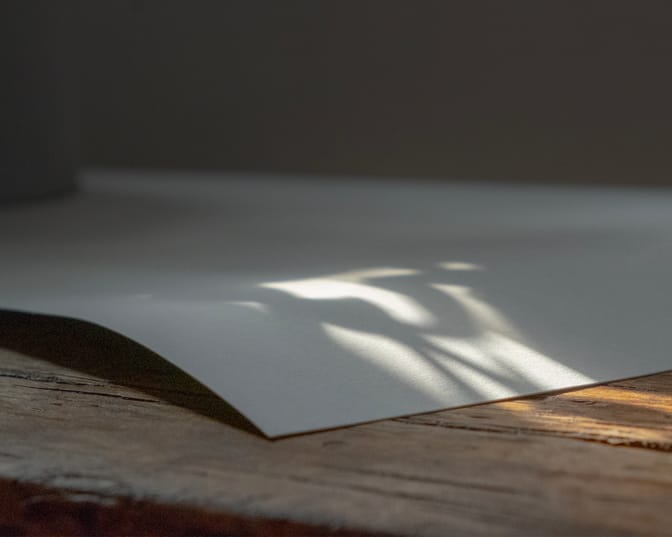
Compare that to a poster, which is printed on coated wood pulp paper. It's thin, it's shiny, and it will start yellowing within a couple of years. The difference is obvious the second you hold both side by side. If you want the deeper dive, I wrote about our paper and print materials here.
The Ink
Not all ink is created equal. Our prints use archival pigment inks, which are rated to last 100+ years under normal display conditions. Pigment particles are solid, they sit on the paper surface, and they resist UV light. They don't break down the way cheap dye-based inks do.
Dye inks (the kind in your home printer and most posters) start fading within months. Hang a dye-based print in a room with a window and you'll notice the colour shifting before the year is out. Pigment inks don't do that. I wrote a whole post about archival inks vs regular inks if you want the details.
The Printer
Professional giclée printers use 8 to 12 ink channels. That means more shades of every colour, smoother gradients, deeper blacks, and details you can see up close without it falling apart into dots. Your home printer has 4 to 6 ink channels and a fraction of the colour range.
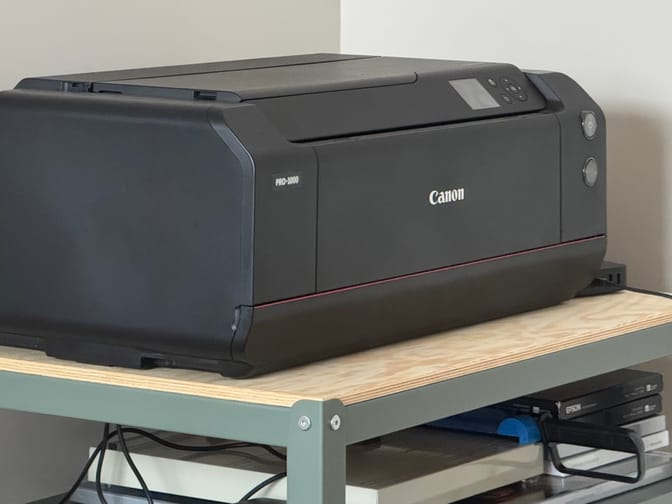
Our imagePROGRAF PRO-1000 printer in all his glory!
We actually have a Canon imagePROGRAF PRO-1000 in our studio for test printing. Every new design gets proofed in-house before it goes to production. If the colours don't match the original, it doesn't ship. Sometimes it takes five rounds of adjustments to get it right.
Colour Management
This is the unglamorous part that nobody talks about. A painting on a screen looks different from a painting on paper. Backlit vs reflective, RGB vs pigment, screen calibration, paper white point, all of it matters.
Every print we sell has been colour-matched to the original artwork. Someone (me) sat in front of a screen and a test print, side by side, adjusting until they matched. A poster doesn't get this treatment. A poster gets "close enough" and out the door.
The Artist
The original painting took hours. Sometimes days. It's not a stock image pulled from a database, and it's not generated by AI. A specific human (that would be me) had a specific idea and spent real time making it real. The print is a reproduction of that painting, not a product assembled from parts.
Fulfillment and Packaging
Our prints are produced by professional fine art studios in the US, UK, and France. They're quality-checked, carefully packed, and shipped from whichever studio is closest to you. A UK customer's print ships from London. A US customer's print ships from Kentucky. Here's how the packaging works. Free worldwide shipping is included in every order.
What You're NOT Paying For
We don't mark up ten times and pocket the difference. Margins on fine art prints are genuinely tight, especially when you include free shipping to every country we sell to. The price covers paper, ink, printing, colour proofing, professional packaging, and delivery to your door. What's left is enough to justify making the next painting. That's about it.
This isn't luxury brand pricing. It's cost-of-quality pricing.
The Poster Comparison
Look, posters are fine for what they are. They're cheap, they're easy, and they serve a purpose. But they're a different product entirely. A poster is something you tape to a wall in college and throw away when you move. A fine art print is something you frame, hang, and keep for twenty years.
If all you need is colour on a wall, a poster works. If you want something that holds up close, feels substantial in your hands, and won't look faded and sad in two years, that's what a giclée print is for.
Different products for different purposes. Neither is wrong, but knowing the difference helps you decide what's worth it to you.
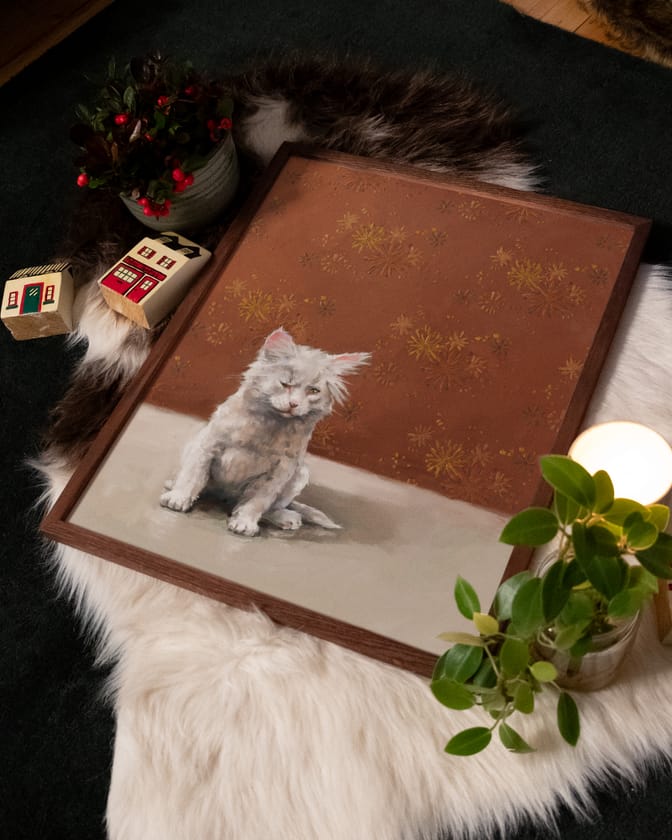
One Eye Pete chilling on a rug
Browse our art print collections to see what we mean. Everything is printed on museum-grade cotton paper with archival pigment inks, with free shipping worldwide.