

A quick back-story
For years, every time I adjusted the colours on a painting, the only way to check the result on paper was to send the file to one of my printing partners, wait for a proof to arrive in the mail, evaluate it, make changes, and send it again. A single round of colour tweaks could take weeks. Multiply that by however many prints are in the shop and it adds up fast, both in time and courier fees.
In 2024 I decided the studio needed its own fine art printer. Not to replace my printing partners (they handle the bulk of day-to-day fulfilment and they're better equipped for it), but to bring colour decisions in-house. If I adjust the warmth on a piece at 2pm, I want to hold the proof by 2:30pm. That was the goal.
What I needed
The requirements were pretty specific:
Pigment-based inks for archival quality. Every print I sell uses archival pigment inks, so my proofing printer needed to use them too. There's no point checking colour accuracy on a dye-based printer if the final product is pigment-based. The colour behaviour is different.
Sheet size up to 17 × 22 inches. Large enough for gallery-size proofs but still something that fits on a desk in a Montreal apartment studio. I didn't need or want a 24-inch wide-format machine.
Accurate colour reproduction. This is the whole point. If the proof doesn't match what the partner labs produce, the printer is just an expensive paper warmer. I needed something with a wide colour gamut and proper ICC profile support.
Low-maintenance nozzle system. Fine art printers that sit idle for a few days between prints are notorious for clogged nozzles. I don't print every day, so I needed something that could handle irregular use without requiring a half-day cleaning ritual and half a cartridge of wasted ink every time I turn it on.
Reasonable cost per print. The whole point was to stop paying for courier shipments of test proofs. If the ink cost per proof was too high, the math wouldn't work.

You can see the printer here along with a bunch of our other studio equipment and greeting cards!
The shortlist
I spent about two weeks going through spec sheets, review videos, and forum threads. Three printers made the cut:
Model |
Pros |
Cons |
|---|---|---|
Epson SureColor P900 |
Roll-paper adaptor available; strong black and white output; 10-colour UltraChrome HDX inks |
Roll unit adds cost; reported clogging issues if left idle for more than a few days |
Canon imagePROGRAF PRO-1000 |
12-colour LUCIA PRO inks; built-in nozzle compensation system; rich blacks via Chroma Optimizer; handles heavy papers well |
No roll feed option; heavier and larger footprint than the P900 |
Epson SureColor P700 |
Smaller footprint; same HDX ink set as the P900; good entry point |
Max sheet size 13 × 19 inches (too small for my needs); slower print speed |
The P700 dropped out immediately because of the sheet size limit. The real decision was between the P900 and the PRO-1000.
Why the Canon PRO-1000 won
12-colour LUCIA PRO pigment ink set
Most consumer inkjet printers use four to six ink colours and mix everything from those. The PRO-1000 uses twelve, which means it can hit colours that a smaller ink set has to approximate. In practice, this shows up most in tricky mid-tones and saturated colours that would otherwise look slightly muddy or shifted. The oranges in pieces like Fukuoka Cat and the deep indigos in The Fox come out accurate rather than "close enough."
The ink set also includes a Chroma Optimizer, which is essentially a clear coat that evens out the surface texture of the print. Without it, areas of heavy ink coverage can look glossy while lighter areas stay matte, creating an uneven sheen called bronzing. The Chroma Optimizer eliminates that, and it makes blacks look velvety instead of washed-out grey.
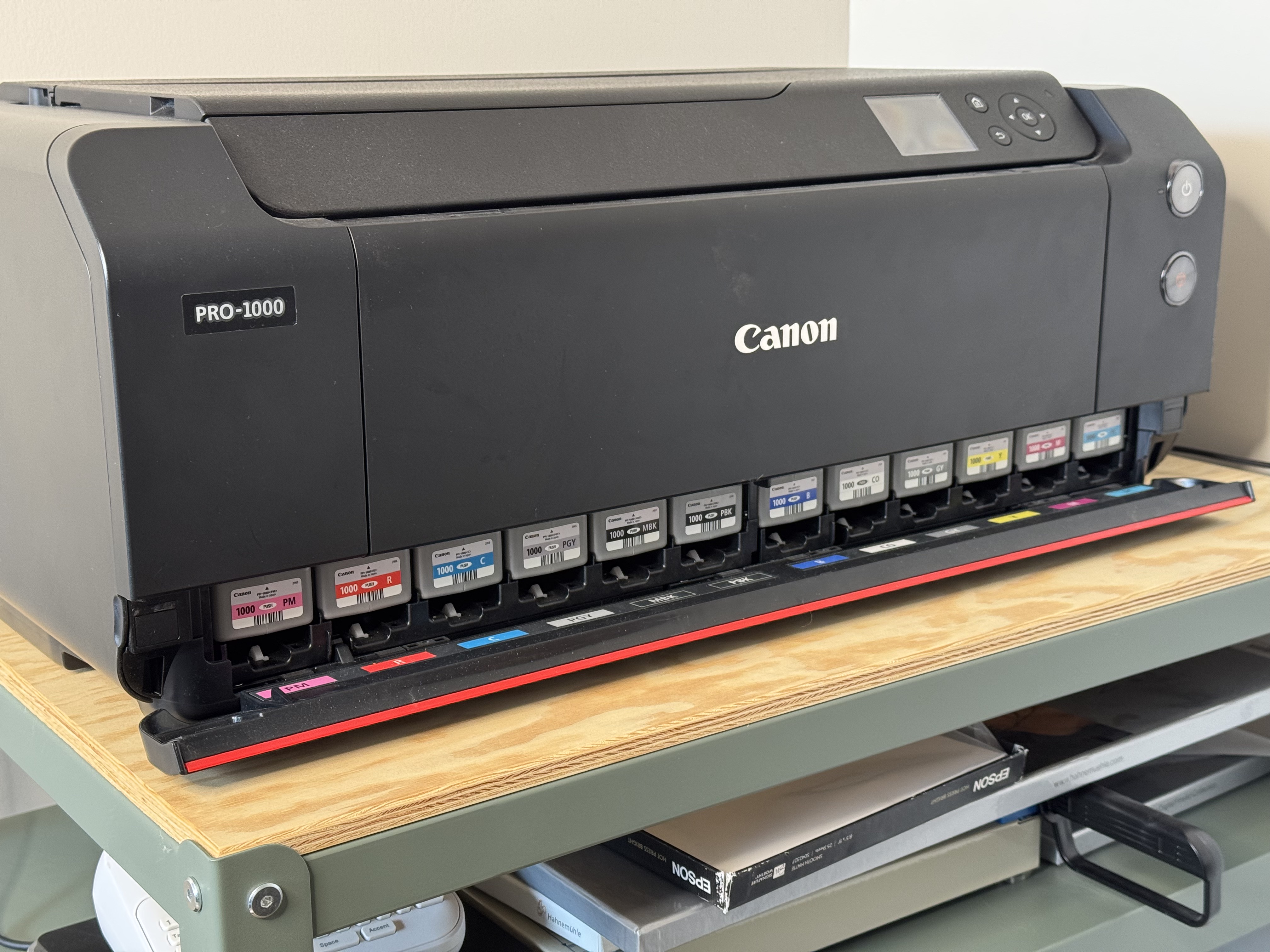
Our imagePROGRAF PRO-1000 with the ink panel open, showing the 12 ink cartridges
Built-in nozzle compensation
This is honestly what sealed the deal. The PRO-1000 runs a nozzle check before each print and if it detects a clog, it reroutes ink through neighbouring nozzles rather than refusing to print or leaving visible banding. For a studio like mine that prints in bursts rather than every day, that's a big deal. The Epson P900 has a good print head too, but the forums were full of people dealing with clogs after a week of inactivity. I didn't want to babysit a printer.
Handles heavy cotton rag paper
Fine art papers are thick. The cotton rag and alpha-cellulose papers I use are in the 270 to 310 gsm range, which is significantly heavier than what most printers are designed for. Anything over about 250 gsm needs to go through the manual rear feed tray rather than the standard cassette. That's true of every printer in this class, not just the Canon. But the PRO-1000's rear tray handles single-sheet manual feeding cleanly. No corner dings, no roller marks. Proofs come out looking sale-ready.
Colour management that actually works
This part matters if you care about consistency between your home proofs and what the printing partners produce. The PRO-1000 supports full ICC colour management with selectable rendering intents. I use Relative Colorimetric with Black Point Compensation turned on, which is the standard setting for fine art giclée reproduction. That same setting goes into the files I send to my printing partners, so the proof I hold in my hands at home should match what comes off their presses.
It's not perfect. Every printer, paper, and ink combination produces slightly different results, and there's always some variation between my Canon and the Epson wide-formats at the labs. But it's close enough that I can make confident colour decisions at home without waiting for a mailed proof.
Running costs
Let's talk money, because the cartridges aren't cheap. Each LUCIA PRO cartridge runs about $80 CAD, and there are twelve of them plus the Chroma Optimizer. A full set of cartridges from empty is a significant outlay.
In practice, a full-colour 17 × 22 inch proof costs roughly $4.60 in ink, not counting paper. That's far cheaper than paying a lab to print and ship a proof every time I want to check a colour adjustment. The math worked out within the first few months.
One thing worth noting: you have to use Canon's OEM LUCIA PRO cartridges. There are no compatible third-party cartridges available, and even if there were, using non-OEM ink would void any claim of archival quality. The whole point of pigment inks is tested longevity, and that testing is done with the manufacturer's own ink. Swap in an off-brand cartridge and you're guessing. So factor in OEM ink costs as non-negotiable if you're buying this printer for archival work.
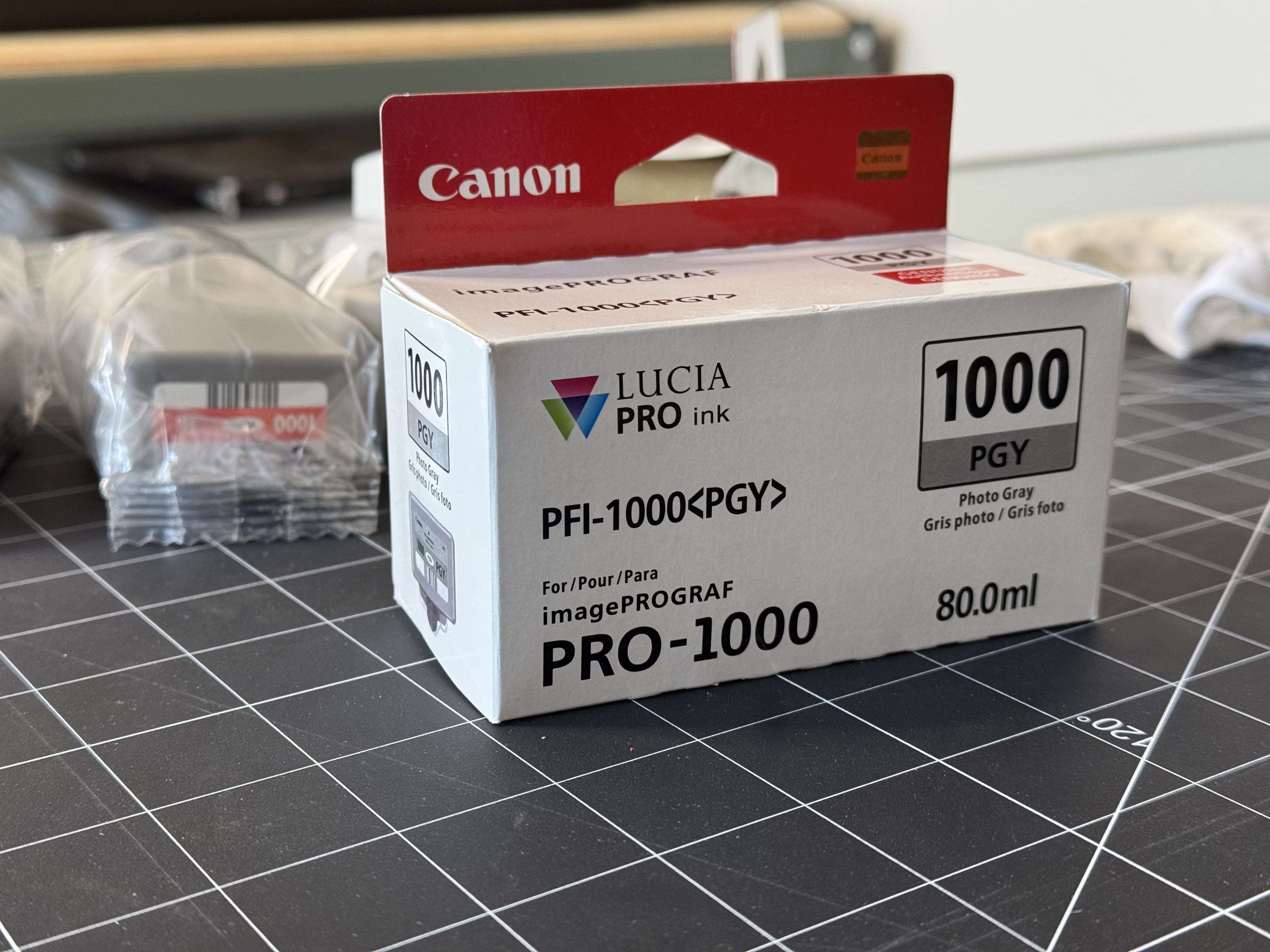
Expensive genuine Canon Lucia PRO ink cartridge
The printer also uses ink for automatic maintenance cycles (head cleaning, nozzle checks). It's noticeable. If you barely print, a meaningful percentage of your ink goes to keeping the nozzles clear rather than making prints. For my usage pattern it's fine, but it's worth knowing about.
How it fits my workflow
Proofing new artwork. This is the primary job. When I finish a new painting or adjust colours on an existing one, I print a proof at home before sending the final file to the partner labs. I can hold it up next to the screen, check it in different lighting, and make adjustments immediately. What used to take a week of back-and-forth now takes an afternoon.
Limited editions and one-offs. Occasionally I print small runs or single prints in-house for rush orders, samples for retailers, or limited edition releases on special paper. The quality is identical to what the labs produce, just on a smaller scale.
Colour reference archive. I keep at least one in-house proof of every print as a colour reference. If a customer ever has a question about colour accuracy, or if I need to compare a new batch from a printing partner against the original, I have a physical reference on hand.
Most of the prints you order from the shop are still produced and shipped by my printing partners. They have the large-format presses, professional packing lines, and shipping infrastructure that my small studio can't match. The PRO-1000 handles proofs, limited runs, and quality control. The labs handle everything else.
The downsides
It's slow. A 17 × 22 inch print takes close to seven minutes. Here's a not-so-short clip of it in action: watch it print. For proofing, the speed doesn't matter. If I were trying to fill orders with it, I'd lose my mind.
It's heavy. About 70 pounds (32 kg). Getting the box from the car, up two flights of stairs, and onto the desk in my studio required two people, a trolley, and some creative problem-solving. Once it's in place, it stays in place.
Maintenance ink consumption. I mentioned this above, but it's worth repeating. The automatic cleaning cycles use real ink. If you go a week without printing, expect the printer to run a cleaning cycle when you turn it back on. It's the trade-off for reliable nozzle performance, and I'll take it over dealing with clogs, but it does add to the cost of ownership.
No roll feed. The PRO-1000 is sheet-fed only. If you need to print panoramic formats or long banners, this isn't the machine. For my work it's not an issue since all my prints are standard sheet sizes, but it's a limitation worth knowing about.
A note on the Canon PRO-1100
Canon released the imagePROGRAF PRO-1100 in early 2025. It uses the same 12-colour LUCIA PRO ink set, adds an optional roll-feed adapter, and has a modest speed improvement. I stayed with the PRO-1000 because I got a strong studio discount that made it the more practical choice, and the newer features didn't change anything about my workflow. If you're buying new today and the price difference is small, the PRO-1100 is probably the better pick. But the PRO-1000 is not an inferior printer. Same inks, same colour science, same output quality.
Would I recommend it?
For illustrators, photographers, and small print studios that need in-house proofing capability and occasional short-run printing, yes. It's the best balance I found between print quality, reliability, and footprint. The colour accuracy is excellent, the nozzle compensation system actually works, and the output on cotton rag paper is genuinely beautiful.
It's not a production printer. If you're filling dozens of orders a day, you need a lab or a faster wide-format machine. But for a studio like mine where the printer's job is to keep colour decisions fast and accurate, the PRO-1000 earns its desk space every week.
— Catherine